Podcast Episode 7: What Is ESG, really?
ESG (Environmental, Social and Governance) has become part of the established lexicon of business but what does it mean and why is it so important to the purpose of businesses across different sectors.
The concepts behind ESG are not new. When the marine biologist Rachel Carson published her ground breaking book Silent Spring in 1962 (where she unpacked the widespread misuse of DDT in pesticides), she challenged the assumption that economic and technological progress could be separated from corporate impact on the natural world. More than sixty years later, we have travelled through increased environmental regulation, the emergence of corporate social responsibility and the increase in sustainability considerations to today’s ESG debate yet we are still grappling with the same fundamental question: what impact does business have on the world in which it operates within? For people and planet.
It echoes the thinking of management expert Charles Handy, who argued that the purpose of business should be about more than simply making a profit. Profit enables a business to do something more worthwhile. Every organisation has an impact through its people, supply chains, energy usage, communities and the places it operates. And in a world where climate disruption and nature resilience is having direct impact on our livelihoods, there is always more work to do to accelerate change.
In this episode of The Purpose Brief, we strip away the jargon and ask what ESG actually means, why it matters, and how can businesses begin to turn good intentions into better business. Please see this an intro to ESG thinking here in the UK for business leaders who are beginning to think more broadly on business impact and their trusted operational leads who are delivering measurement of impact on business activities on the ground.
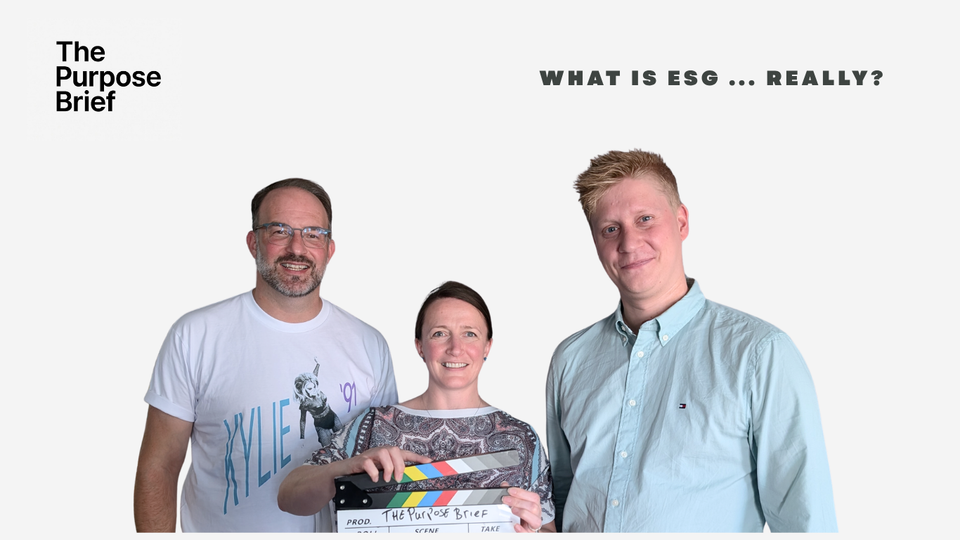
James is joined by Justine MacArthur, an independent consultant working across people, culture and HR, and Dane Wadsworth-Thurnham from JZ Flowers, one of the largest producers of floral bouquets for UK and global retailers, to look at what responsible business looks like in practice.
There are no simple answers to what is a complex issue. Instead, there are lived examples: options for logistics for big distribution businesses, measuring social impact, persuading people across an organisation to get on board and tracing the journey of products from supply networks across the world to meet UK consumer demand.
The conversation also challenges some familiar assumptions and the complex role of humans in making the world more sustainable. People don't necessarily dislike change for the better, they dislike change being done to them at cost. Sustainability isn't just about spreadsheets, procurement and financial reporting. It should be part of how a business operates and the culture set by it's leaders. There is a lot here about being aware of your responsibilities, the role of accountability for leadership teams and the importance of building public trust alongside regulatory considerations.
ESG can feel like a minefield of frameworks, regulations and competing demands and in the face of kick back and roll back (particularly in the USA) around protections for the environment against profit on the markets, we ask what does this means for us as employees or leaders.
This episode cuts through some of that noise and asks a more practical question: how do you build a business that is resilient, responsible and fit for the future without losing sight of the people who make it work.
In this episode we will cover:
- Why stripping away the jargon matters
- How purpose, leadership, HR and sustainability connect
- How to communicate sustainability effectively
- The tension between carbon reduction, cost, waste, freight and supply-chain realities
- Why traceability and fair-trade premiums matter to customers
- The challenges organisations face when funding rules restrict what “social value” can mean
- Why governance matters, and what happens when sustainability depends on the people at the top
This is, of course, just a top level insight into a much bigger set of challenges which we will pick up some in more detail in future episodes.
We would like to thank colleagues at Hull University Business School who ran a course earlier this year as part of their executive programme on ESG Leadership. With fantastic thinking from some of the brightest academic minds, Justine, Dane and myself joined a group of other real life humans working hard to deliver ESG in their organisations. That insight and camaraderie was invaluable to us and you can hear this enthusiasm and hope in this episode, which was incidentally recorded at Pocklington Arts Centre in the East Riding of Yorkshire.